
Proving Fit-for-Purpose Monitoring Can Cost a Fraction of the Traditional Approach
For any CO₂ storage project, monitoring is not optional — it is a regulatory obligation that runs for decades, long after injection stops. But the cost and intrusiveness of conventional monitoring can be a major drag on project economics.
This techno-economic study by CO2CRC puts eight monitoring technologies on a like-for-like commercial footing, from established 4D seismic through to the innovative downhole seismic and pressure-tomography techniques developed at the CO2CRC Otway International Test Centre — and quantifies just how much can be saved by choosing the right monitoring strategy.
30x lower cost
Downhole seismic and pressure tomography come in at roughly 30 times lower cost than 4D seismic, while achieving a 0.9 probability of detection — versus 0.6 for 4D seismic — and monitoring every two years rather than every five.
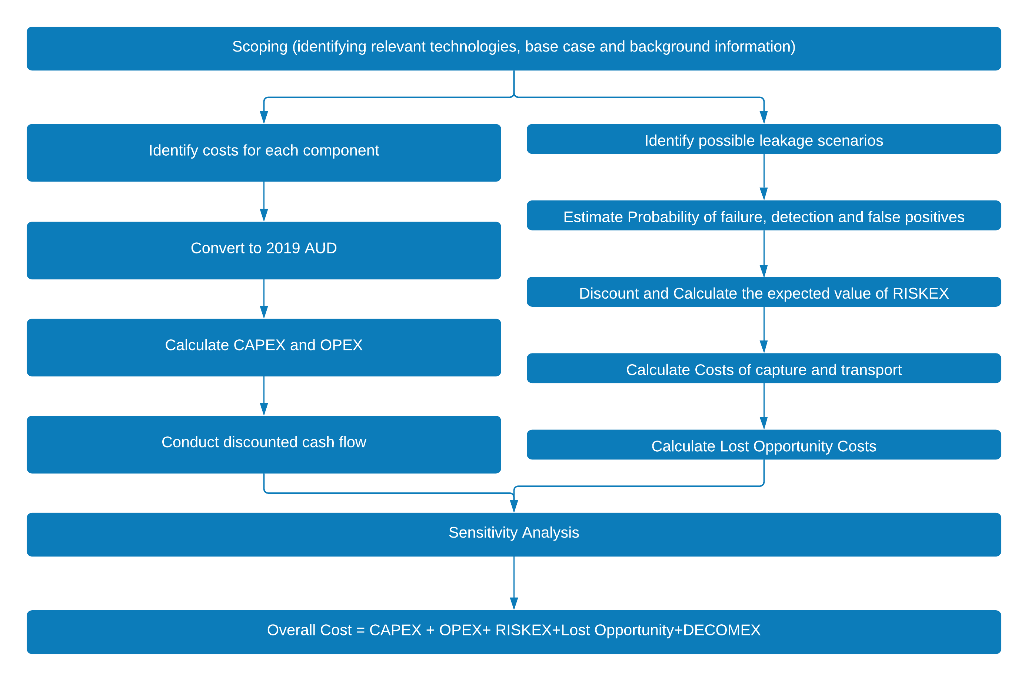
The techno-economic workflow: parallel costing of monitoring expenditure and risk-based expenditure, combined into a single whole-of-life cost.
Project goal
Client
CO2CRC Ltd — Otway Stage 3 Project
Asset
Onshore CO₂ storage & monitoring test site
Location
Otway International Test Centre, Victoria, Australia
A Full-Lifecycle View of Monitoring Cost and Risk
This preliminary techno-economic assessment compares the whole-of-life cost of monitoring and verification (M&V) across a modelled CCS project of 25 years of injection followed by 25 years of post-injection monitoring. Crucially, it goes beyond simple capital and operating cost. It brings capture-and-storage risk into the same commercial frame — costing the expected consequences of a CO₂ containment (migration) event, and the lost-opportunity cost if a project has to be decommissioned early. All figures are reported on a 2019 AUD basis.
The analysis is powered by a purpose-built costing toolkit — the analytical engine behind CO2Tech's COSMIC costing software — which lets operators re-run any scenario for their own site geology, injection profile, risk appetite and economic assumptions.
What the assessment covered
- Eight monitoring technologies benchmarked head-to-head: 4D seismic, microseismic, temperature gauges, gravimetric analysis, InSAR and electrical resistance tomography (ERT), compared against the two novel Otway Stage 3 techniques — downhole seismic and pressure tomography.
- Three cost layers integrated into one number: capital expenditure (CAPEX), operating expenditure (OPEX), and a probabilistic risk-based expenditure (RISKEX) capturing the cost of detecting — or failing to detect — a leak.
- A risk-and-detection model built around each technique's real-world monitoring frequency and probability of detection, plus the cost of early vs late detection across six containment-failure scenarios.
- Sensitivity analysis on the assumptions that matter most — probability of detection, false-positive rates, and remediation costs — to show where the estimates are robust and where they hinge on further data.
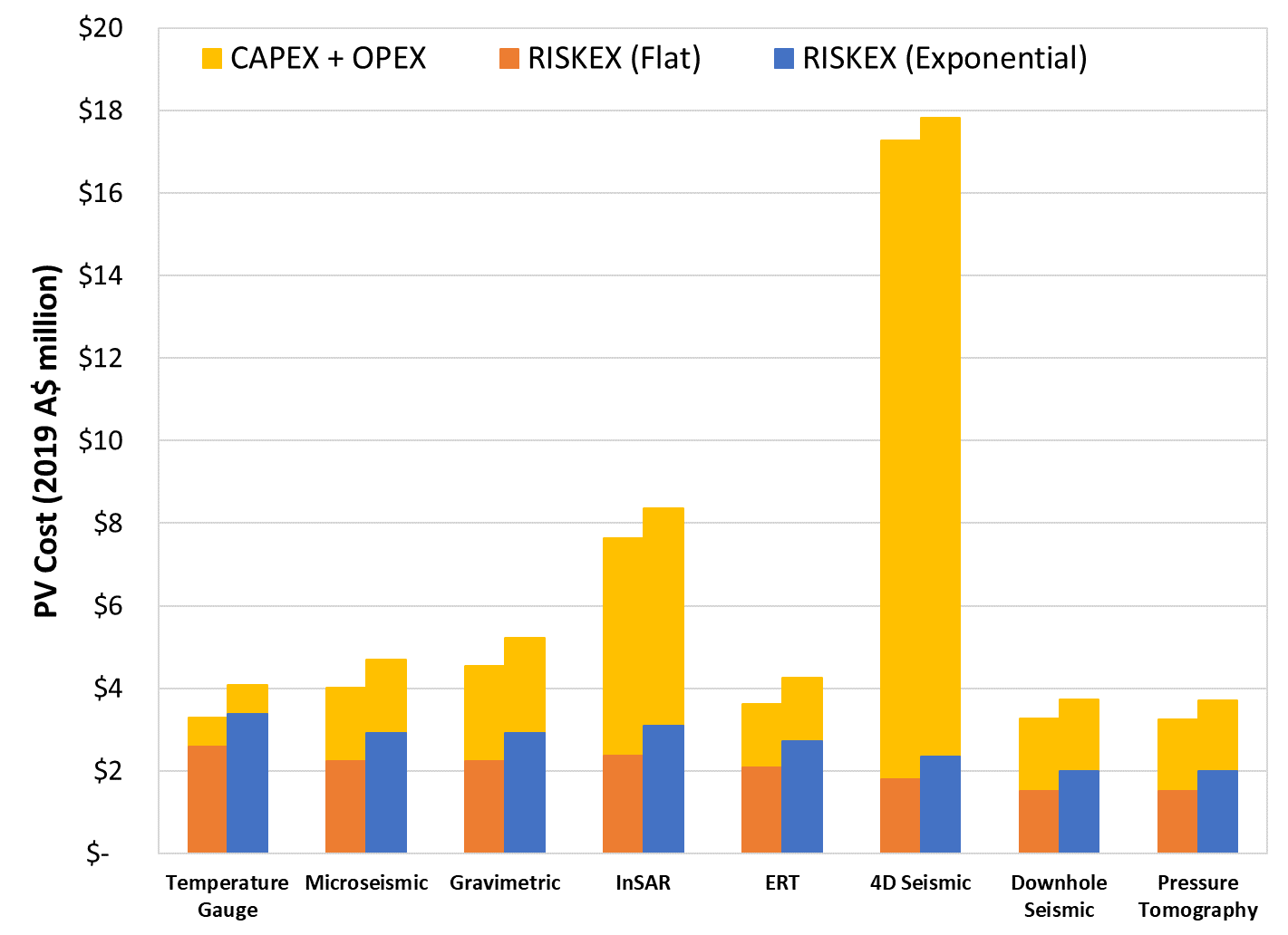
Whole-of-life monitoring cost including risk (PV, 2019 A$ million). 4D seismic dominates the cost profile, while the novel Otway Stage 3 techniques sit among the lowest-cost options.
Where We Found the Value
Beyond ranking the technologies, the study surfaces where monitoring dollars are actually won or lost — the difference between a generic cost estimate and a decision-ready assessment.
Innovative techniques deliver comparable accuracy at a fraction of the cost
- On basic CAPEX + OPEX alone, downhole seismic and pressure tomography come in at roughly 30 times lower cost than 4D seismic, while achieving a 0.9 probability of detection — versus 0.6 for 4D seismic — and monitoring every two years rather than every five.
- Because the novel techniques use permanently installed, subsurface infrastructure, they enable on-demand, near-real-time monitoring once in place, with lower community-engagement, environmental and societal costs than campaign-based surface seismic.
Bringing risk into the cost picture
- The study developed a defensible method to price the expected cost of a containment event (RISKEX) and the lost-opportunity cost of early decommissioning — costs usually left out of monitoring comparisons entirely.
- Sensitivity testing showed the results are far more sensitive to probability of detection and false-positive rates than to the remediation cost assumptions themselves — pinpointing exactly where better field data would most improve confidence.
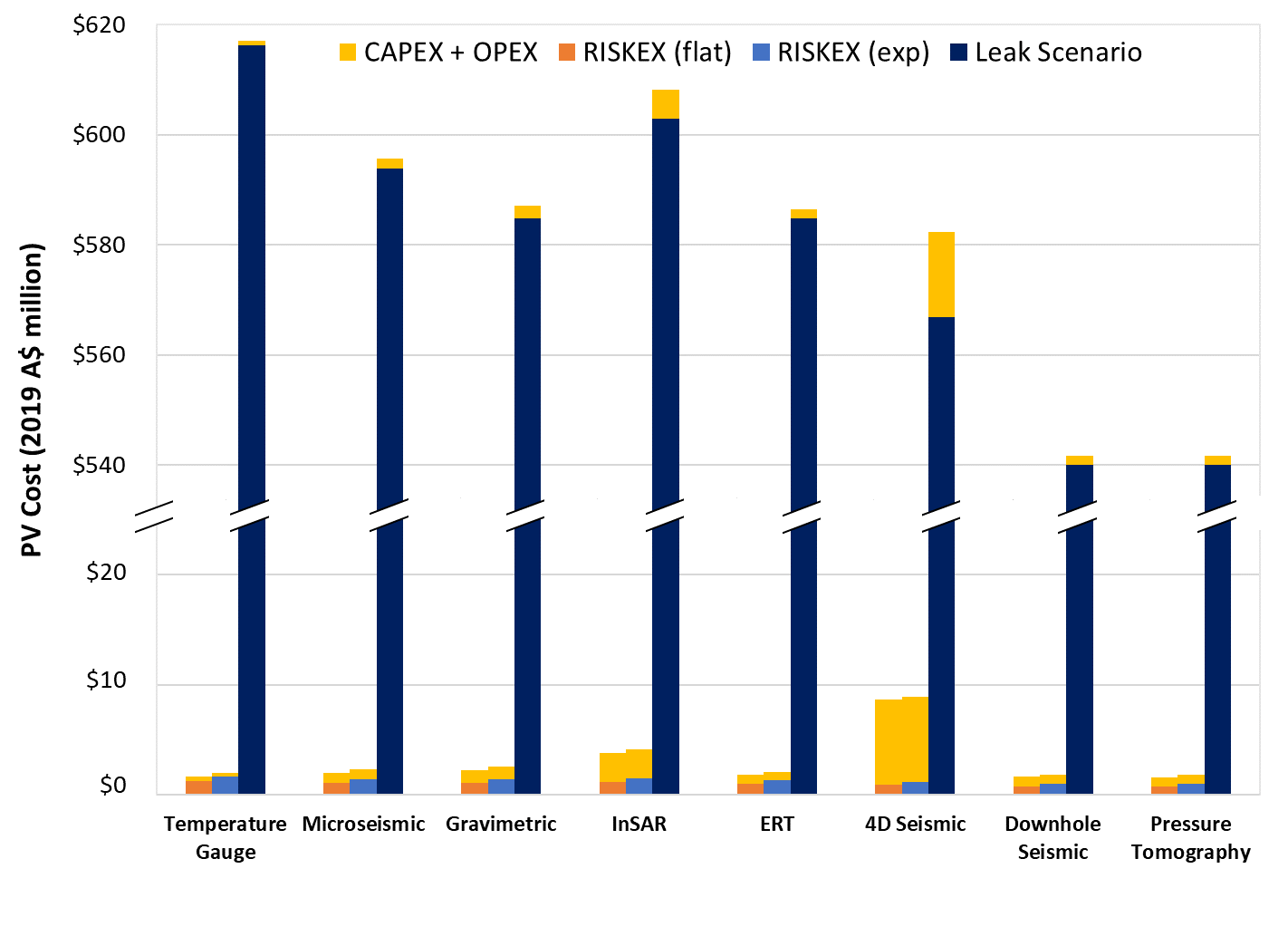
The scenario that matters most: cost if a leak actually occurs. High-detection techniques — 4D seismic and the two novel methods — contain the consequences at the lowest cost.
The Bottom Line
4D seismic costs about 13× more than the two Otway Stage 3 techniques combined*.
*Low-cost scenario: ~A$79.2M for 4D seismic vs A$3.1M (downhole seismic) + A$2.8M (pressure tomography).
Under the high-cost scenario the gap is wider still: A$299 million versus A$11.7 million and A$11.4 million. Yet cost is only half the story. Because the novel techniques monitor more frequently and detect more reliably, they also perform strongly in the scenario that matters most — if a leak actually occurs, high-detection-probability techniques (4D seismic and the two novel methods) contain the consequences at the lowest cost. The Otway Stage 3 techniques therefore offer a rare combination: lower cost, higher monitoring frequency, and comparable or better leak-detection reliability.
For operators facing decades of monitoring obligations, that is the difference between monitoring as a compliance burden and monitoring as a managed, optimised cost.
Cost estimates are preliminary and accurate to approximately ±30% (2019 AUD basis). They are intended as a comparative decision-support benchmark, not a definitive project cost.
Why CO2Tech
CO2Tech has unrivalled practical experience in capturing CO2 from industrial emissions in Australia. It can leverage its unique access to advanced storage projects providing the crucial connection between carbon capture and permanent underground CO2 storage.
If you’re a manufacturer, refinery, ‘Safeguard Facility’, etc. that is impacted by the Safeguard Mechanism, contact us today to see how CO2Tech can assist in your next steps to tackle your emissions reduction.
Contact Us
Latest Case Studies
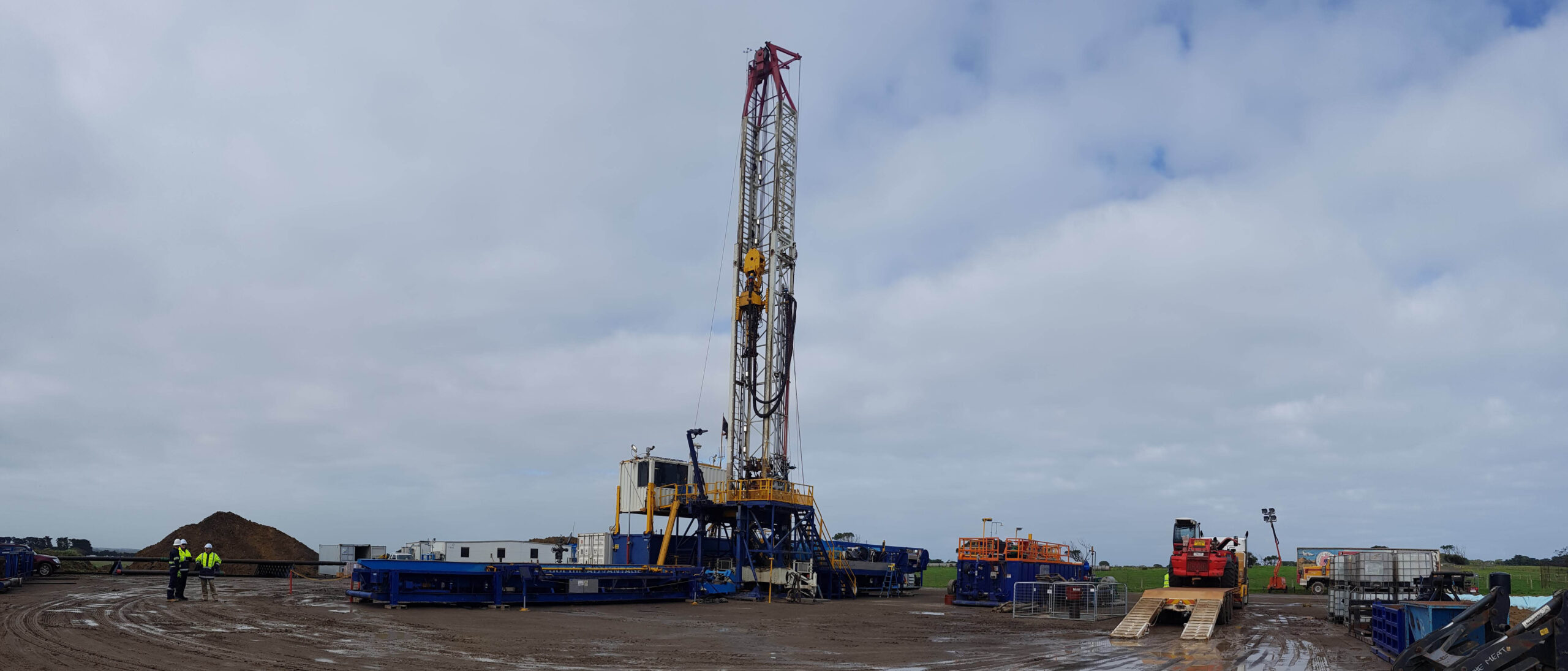
Low-Cost Fibre-Optic Well Monitoring for Geothermal
CO2Tech demonstrated a low-cost fibre-optic monitoring approach for continuous thermal, flow and well-integrity surveillance, enabling remote operation and real-time insight across the well lifecycle.
Continue Reading

Geological interpretation and Dynamic Modelling of Well Data
Geological Characterisation – Undertook a detailed facies analysis and seal capacity analysis to describe the geological character of prospective storage sites targeted by drilling, and develop static (geological) models of
Continue Reading