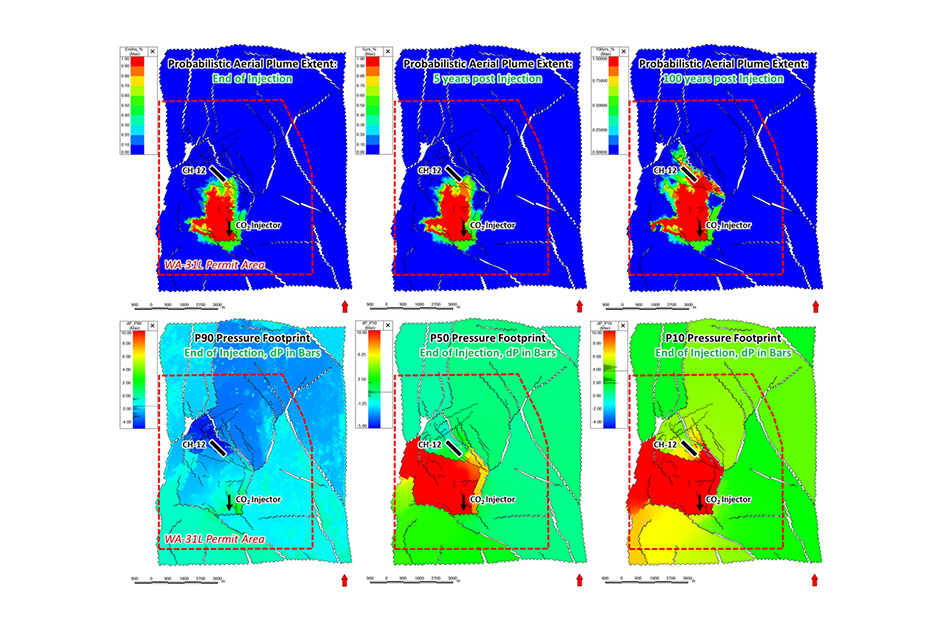
Pilot Energy asked CO2Tech to assist in submitting a declaration of GHG storage formation (DoSF) to NOPTA. This culminated in the creation of our ‘Probabilistic CO2 Plume Modelling’ paper. (doi:10.1071/EP23108).
To learn more about how CO2Tech helped Pilot Energy attain successful approval for the DoSF, read our paper below and scroll down to understand the goals, challenges, and outcomes, from this project.
Project goal
Client
Pilot Energy.
Asset
Cliff Head offshore oil field (depleted), Mid West Clean Energy Project (MWCEP).
Location
120km south of Geraldton, Western Australia.
Pilot Energy required strategic and technical assistance in regulatory requirements for an application for a ‘declaration of an identified greenhouse gas (GHG) storage formation’ (DoSF).
A formative step in progressing a carbon storage project in Australian Commonwealth waters is the DoSF. This regulatory process formally notifies the National Offshore Petroleum Titles Administrator (NOPTA) that the owners of a project have determined a subsurface location where injected GHG substances can be stored permanently. The application requires titleholders to demonstrate the eligibility of a site according to suitability determinants outlined in its associated guidelines.
CO2Tech’s goal was to provide Pilot Energy with a strategic approach to obtain the DoSF as well as all geoscientific and subsurface engineering work required to comprehensively satisfy the technical requirements necessary to achieve approval for the DoSF.

CO2Tech Challenge
Plume migrations and predictions
The challenge involved providing sufficient information on the expected migration pathway(s) of the injected GHG substance to inform the expected behaviour over the life of the GHG storage project and in the longer term.
All migration pathways of which the probability of occurrence is greater than 10% must be considered.
The predictions must be based on the fundamental suitability determinants of the storage formation.
This information must include:
- details of all data used to generate the models
- details of the modelling including methodology, spatial resolution, types of models and assumptions to predict plume migration pathways
- predictions of the migration pathways and probability distributions associated with these predictions.
These predictions should be provided at intervals over the life of the project and in the longer term, and must include at least:
- five years after injection is expected to cease
- the time when the GHG substance has effectively stabilised in the subsurface.
Why CO2Tech
CO2Tech have nearly 20 years experience in delivering projects to the Australian Standard for geological storage of carbon dioxide (AS ISO 27914:2019).
CO2Tech have experienced technical experts that have actually worked on geological sequestration projects so can provide advice that is relevant to commercial CCS projects and based on real world experience.
Contact us today for strategic and technical consulting with your CCS project.
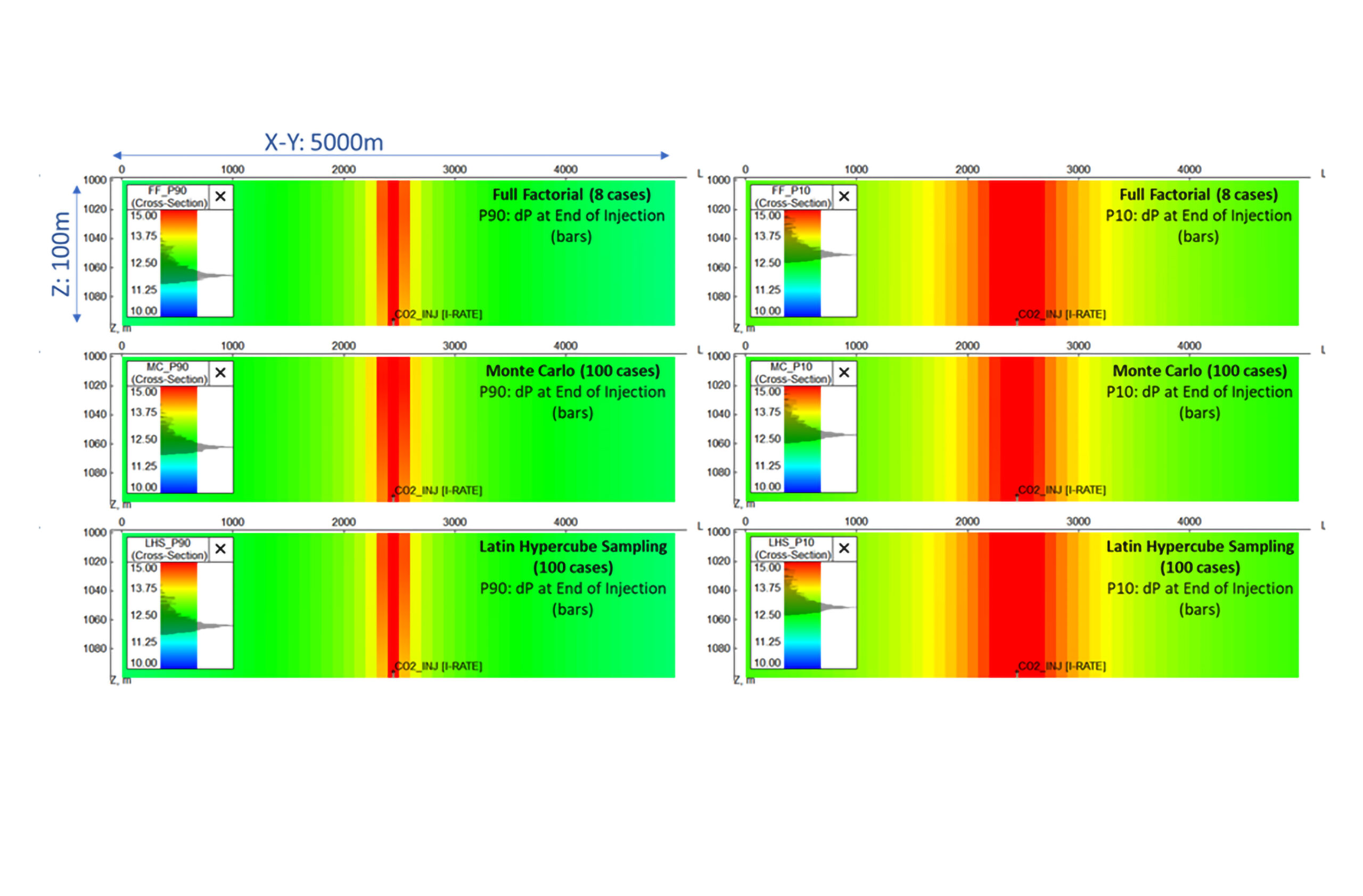
Above: Probabilistic pressure footprints. Cross-sectional maps of P90 and P10 differential reservoir pressures (dP) at the end of injection.
Benefits
Independent verification
Technical experts provided independent verification of the application from initial screening to final submission.
Regulation compliance
Verified that the submission meets the requirements of the statement of environmental objectives: carbon storage and complies with the objectives of the Australian Standard for geological storage of carbon dioxide (AS ISO 27914:2019).
Time saving
Our approach saved a significant amount of time allowing the operator to expediate their plans for their gas and carbon storage operations.
Safety Assurance
Assured compliance through assessment against Australian standards and regulations.
What we did
CO2Tech performed the initial screening of Cliff Head, and for the first time, assessed its storage capacity based on international standards, and determined its suitability as a CCS reservoir, whilst establishing new workflows and assessment criteria aligned with the federal legislation to efficiently provide the necessary techno-regulatory inputs critical to the submission to federal government.
CO2Tech then co-ordinated the subsurface technical evaluation into what is now, the first approved Declaration of Storage (DoS).
The result
The first approved Declaration of Storage (DoS) since Australia’s Offshore Greenhouse Gas Storage Act was passed in 2006.
Pilot Energy plans to commence the first stage of the project in 2026, with the conversion of the depleted Cliff Head offshore oil field into a permanent carbon storage operation able to store more than 1 million tonnes of CO2 a year. That would place the project among the world’s top 10 ranked by CO2 capture capacity.
[Source: Carbon Capture APAC 2024 | 10 July 2024]
[Source: Carbon Capture APAC 2024 | 10 July 2024]
Following on from the approval of the DoSF, Pilot Energy has subsequently been awarded a Greenhouse Gas Assessment Licence. Under the complimentary licences, Pilot can undertake exploration activities targeting both gas and carbon storage opportunities.
Why CO2Tech
CO2Tech has unrivalled practical experience in capturing CO2 from industrial emissions in Australia. It can leverage its unique access to advanced storage projects providing the crucial connection between carbon capture and permanent underground CO2 storage.If you’re a manufacturer, refinery, ‘Safeguard Facility’, etc. that is impacted by the Safeguard Mechanism, contact us today to see how CO2Tech can assist in your next steps to tackle your emissions reduction.
Contact Us