Turning CO₂ Compliance Into Competitive Advantage
For companies advancing their participation in Australia’s emerging carbon capture and storage (CCS) market, an independent techno-economic study delivers exactly what decision-makers need: a clear-eyed, data-driven comparison of pathways for capturing, transporting and storing CO₂ and a roadmap for where capital and operating costs can be meaningfully reduced.
This work by CO2Tech provides a commercial benchmark for interested parties on the cost of CO2 avoided if an LNG plan in Queensland were to seek options for Carbon Capture and Storage within Australia.
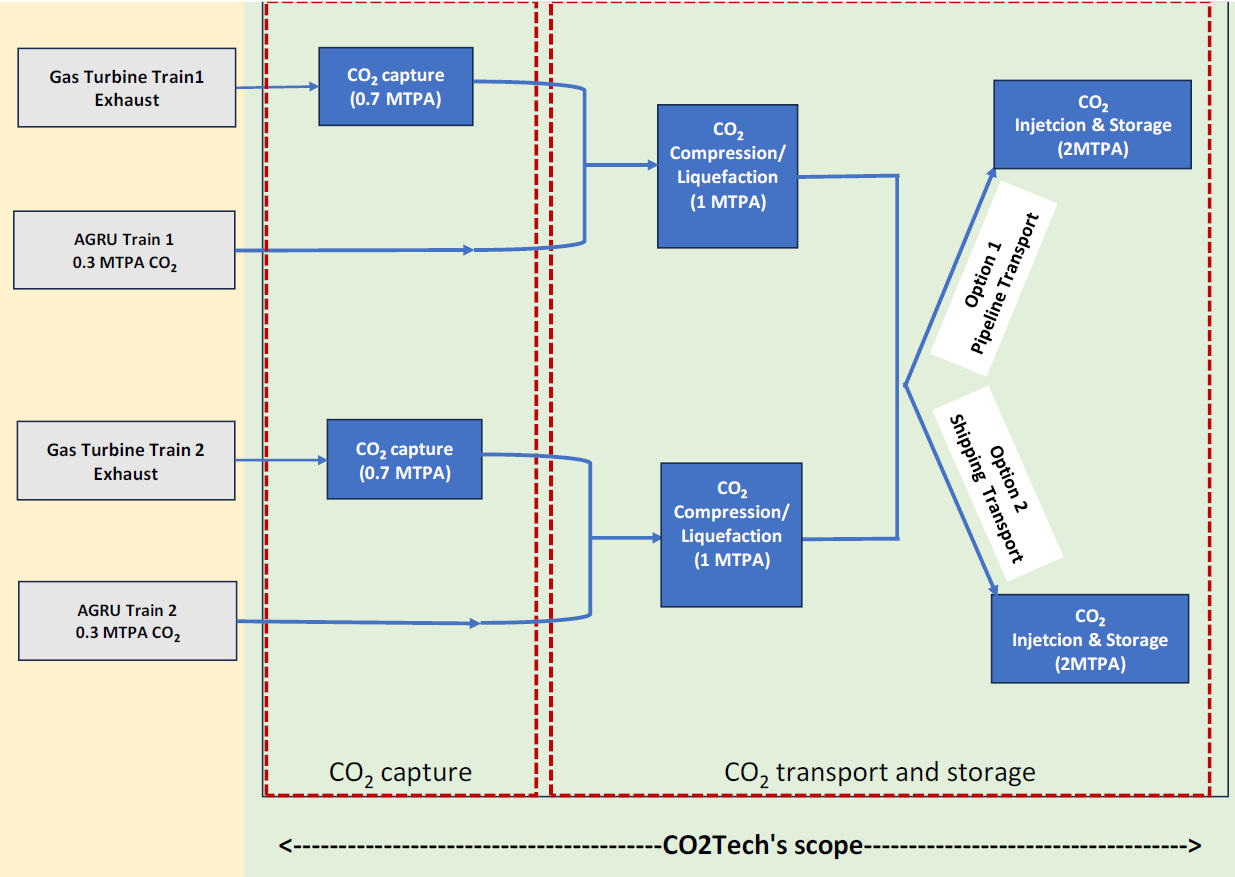
Example: CCS-Scope-Chart
Project goal
Client
Engineering and Construction company (Korea).
Asset
LNG Plant
Location
Queensland, Australia
A Complete Picture of the CCS Value Chain
This Class 5 (AACE) techno-economic assessment evaluates the full chain — from post-combustion CO₂ capture at twin gas turbine trains, through compression and liquefaction, to two distinct transport and storage routes — providing a robust, defensible basis for investment decisions and stakeholder conversations.
- Capture: MEA-based solvent absorption from gas turbine exhaust, enhanced with 40% flue gas recirculation (FGR) for stronger capture performance at lower cost.
- Transport Option 1 – Pipeline: 600 km dense-phase pipeline from Gladstone to a potential on-shore storage site in the Surat Basin.
- Transport Option 2 – Shipping: Liquefied CO₂ shipped 2,100 km to the Gippsland Basin, leveraging Australia's proven LNG shipping expertise.
- Market context: A full regulatory and commercial landscape review covering Australia's major CCS projects, the OPGGS Act approvals pathway, state-specific legislation and the Safeguard Mechanism crediting system.
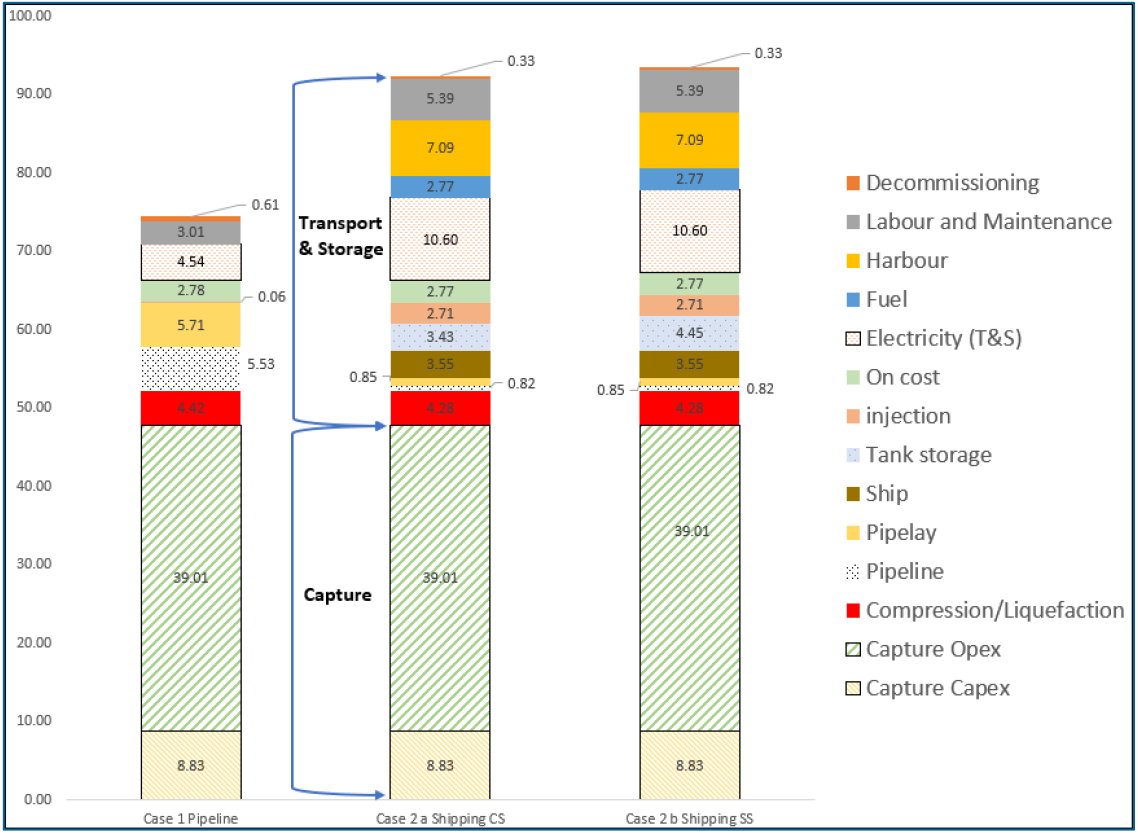
Example only: Cost of CO2 capture for full CCS chain.
Where We Found the Value: Cost & Optimisation Examples
Beyond simply costing two options, this analysis surfaces concrete, actionable opportunities to strip cost out of both the capture process and the transport chain — the kind of insight that distinguishes a bankable feasibility study from a generic estimate.
With the majority of project cost focused within these two key elements of the value chain, reductions in cost here can materially affect the overall project commerciality.
Capital Efficiency Through Smarter Process Design
- Flue gas recirculation (40%) cuts the energy penalty of capture by raising CO₂ concentration in the exhaust stream — shrinking absorber and equipment sizing and trimming CAPEX, not just OPEX.
- Solvent selection (MEA) was benchmarked against five alternative chemistries on viscosity, kinetics, degradation and cost — confirming the lowest-CAPEX, lowest-OPEX pathway without sacrificing technology maturity or bankability.
Transport Cost Reduction Levers
- Removing the dedicated injection compression station on the pipeline route — by re-tasking the final booster station — saves approximately US$0.58 per tonne of CO₂, a quick-win design refinement identified directly from the modelling.
- Shifting compression and liquefaction operations to lower-cost, off-peak or renewable electricity periods offers a clear path to reduce the largest single OPEX line item in both transport cases.
- For shipping, bypassing onshore unloading and storage at the receiving port — injecting directly from ship to subsea completion — could cut harbour costs by more than half and roughly halve storage tank capital costs.
- Right-sizing compression trains (three smaller trains rather than one large unit) was shown to be the more capital-efficient configuration at this throughput, avoiding over-investment in oversized equipment.
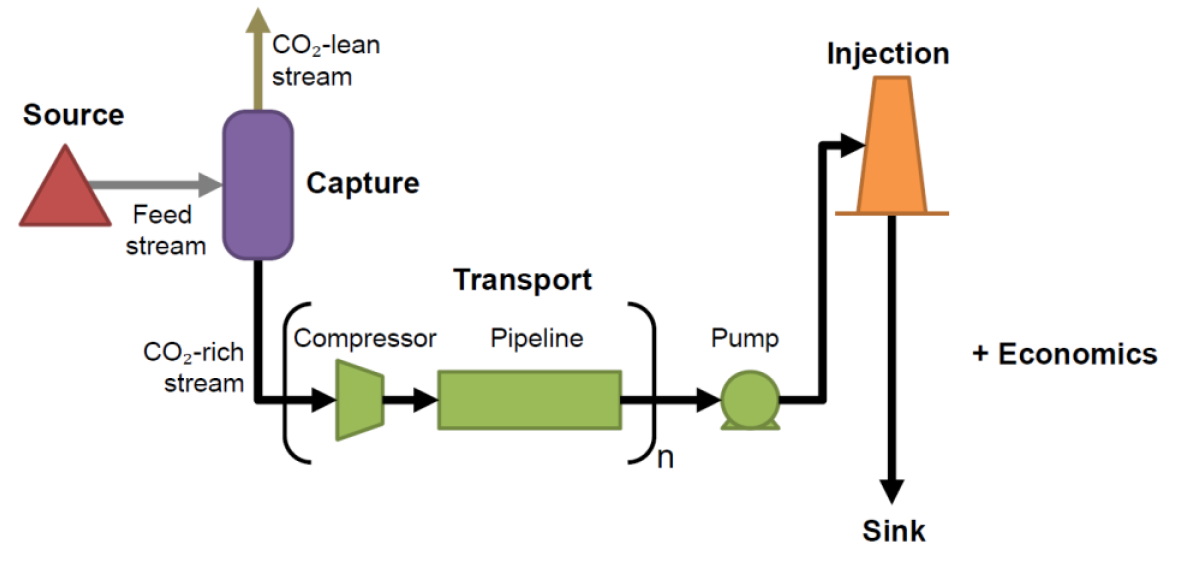
Example: Structure of an ICCSEM project calculation
The Bottom Line
On current estimates, pipeline transport within the specified 600km radius, is the more economically attractive route — roughly 45% cheaper than shipping to Gippsland, at US$26.66 per tonne of CO₂ captured versus US$48.43. However, shipping retains strategic appeal: lower upfront capital outlay, flexibility for smaller initial CO₂ volumes, and the ability to leverage shared port infrastructure as the Gladstone CCS cluster scales, making it a credible bridge solution ahead of a larger pipeline build-out.
With Australia's Safeguard Mechanism tightening emissions baselines through 2030 and CCS projects already in development nationally, the window to secure a competitive position is now. This type of techno economic study equips decision-makers with the cost transparency and optimisation pathway needed to move from feasibility into confident, well-timed investment.
Why CO2Tech
CO2Tech has unrivalled practical experience in capturing CO2 from industrial emissions in Australia. It can leverage its unique access to advanced storage projects providing the crucial connection between carbon capture and permanent underground CO2 storage.
If you’re a manufacturer, refinery, ‘Safeguard Facility’, etc. that is impacted by the Safeguard Mechanism, contact us today to see how CO2Tech can assist in your next steps to tackle your emissions reduction.
Contact US